G. MENTESSI (in a letter to Sandri, 1913))
When is enthusiasm, a bright passion for Art
and great willingness to constantly study as you do, dear Sandri, there
is hope of something very good. You will be able to distinguish yourself
if you kepp on working, as you will no dubit do, with such fervour and
noble aspirations .
P. SINOPICO (in an art column, 1926)
There is a clear-cut, honest impression in
his works that he obviously keeps even under a sparing coating of sombre
light and shade. This artist has acquisted, little by little, simplicity,
expressive directness, concisiveness, and in certain drawings, even a
touch that can be called "masterly".
A. CARPI (on the occasion of a postumous exhibition
in Saronno, 1965)
I didn't see him again after his years at
Brera where he was a pupil of Mentessi and Tallone … it is very moving
to see his work … to admire the deep and solid value of it. The drawings
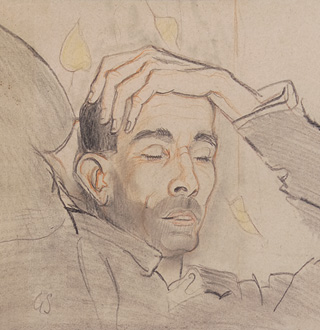
he made while committed to the asylum are very beautiful, some are wonderful.
For those of us who see him now he deserves our utmost respect and sincerest
and highest praise.
L. BRACCHI (on the occasion of a postumous exhibition
in Saronno, 1965)
Gino Sandri was a very dear friend of mine
and together with Emilio Longoni I remembered him with great esteem. I
recall above all his graphic work which is impressive. From a psychological
point of view I especially recall the spendid drawings of the lunatics.
They are real portraits carried out with a dedication worthy of Durer.
They are precise even if simple pencil drawings. We must not forget his
paintings that show his love of nature which he shows simply as if through
the eyes of an innocent child, which our friend Sandri as.
G. NICODEMI (in a monograph "Gino Sandri", 1965)
The best paintings that he has left us are
the countryside scenes . Along with these landscapes we must consider
the great number of portraits. In these pictures we see different types
of people, some illustrious, some humble, but they all have a rosy gleam
of reality.
G. A. DELL'ACQUA (in a review in the Corriere
della Sera of 22.1.1986, and in an introduction to the monograph "A Tribute
to Gino Sandri", 1998)
Sandri is an artist who had a clear understanding
of himself even in the worst period of his life. The drawings he did while
committed to hospital are an excellent evidence of this. A part from the
striking clarity of design, I know no other artist today or at the time
Sandri did this work who can equal him in this. These drawings were done
to exercise his illness, while locked up in an asylum, just as Van Gogh
did by frenetically painting. However, they also helped him to live and
to console his equally suffering companions. All together in fact they
make up a unique testimony both for the quality of the characters represented,
both for the spirit of human compassione that is depicted in them and
they have no comparison. It is this particular situation that has allowed
Sandri, paradoxically, to offer us the best of himself.
S. GRASSO (from a review in the Corriere della Sera of 14.4.1999)
Gino Sandri was a student of the Brera Academy at the beginning of the century where he worked with great sensibility and intelligence. He was particularly attentive to portrait painting and we can seen this in his work with oils. He was a contemporary of the ‘Scapigliatura' period and he expressed rich humour in his cartoons and illustrations. He also collaborated with periodicals of the Corriere della Sera group. It is at this point that his life takes a dramatic turn when he is interned in a psychiatric hospital, where he spent the best part of his life. Here he managed to draw a series of high quality portraits (fellow unfortunates, doctors, nurses etc.) with great sensibility and professional expertise. The characteristics of each of these people are caught mercilessly but at the same time show an emotional involvement.
R. BOSSAGLIA (at the presentation of the exhibition
at the Gallery S.Fedele in Milan, 1999, and from a review in the Corriere
della Sera of 14.4.1999)
Sandri's style comes from his teachers, from
Mentessi to Tallone. He is capable of giving flavour, freedom and touch
of the late nineteenth century to his painting. He does this giving us
a most modern vision of people, images and expression. The artist had
a very dramatic life, and his story is a tormented one. He was admitted
several times to a psychiatric hospital. What strikes you very much is
this recognition in others and in the attention towards others of suffering.
His exceptional capacity to paint portraits is really very unique. In
this capacity he found, against his will, the possibility of expressing
himself in such a profound and original way that allows us today to underline
its importance.
E. PONTIGGIA (introduction to the art catalogue “Gino Sandri 1892-1959, lights of art, shadows of madness”, art exhibition at the Palazzo dell'Arengario, Monza, 2009)
Gino Sandri has a significant role in the relatively narrow scenario of Italian Expressionism, even though his relevance is not agreed upon by every art critic, basically because little is generally known about his life and work. Sandri's pursuit as a designer – his experience as a painter is different and not so outstanding in fact - epitomises a sorrowful human comedy which has no compare in the Italian context of the time. His series of portraits, in particular, can be related, in some ways, to those of the School of New Objectivity in Germany, even though the former never share the same taste for extremely exaggerated aspects as the latter. The subjects in his drawings are those Sandri used to see around him, as he was secluded in the hospital for mental treatments at Santa Maria della Pietà in Rome (actually a madhouse, as it was called in those days; and such was the place, if one considers the tortures that would occur over there) aged 32, back in 1924. Owing to the harsh reality around him, maybe to the emotions that so many desperate human beings stirred in him, or perhaps to his inbred vocation to deal more with the evil and the sorrow than with the beautiful, he would carry out some of the most outstanding Expressionist portraits of the period in Italy.
